

Most homeowners think the hard part of a hail claim is getting it approved. It isn’t. Approval is just the beginning. The real outcome is decided inside the estimate line by line, detail by detail. That’s where hail damage claim supplements come in, and where thousands of dollars are either recovered… or quietly lost. I’ve seen it happen over and over. A claim gets approved. The homeowner feels relief. The estimate looks clean and official. Then the contractor shows up, reviews the scope, and pauses. Something’s missing. Actually, a lot is missing.
Essential components aren’t listed. Measurements feel off. Code requirements? Not even mentioned. Now the homeowner is stuck in a frustrating position. Move forward and pay the difference? Or stop everything and push back? That gap between what’s written and what’s real is where claims are won or lost. And understanding hail damage claim supplements is what allows you to close it.
What Is a Hail Damage Claim Supplement?
Let’s get clear. A hail damage claim supplement is a formal revision to the original insurance estimate. It adds items that were missed, under-scoped, or incorrectly priced. This isn’t a loophole. It’s a correction.
Here’s how the process usually looks:
- Initial Scope: The insurance adjuster’s first estimate
- Discovery Phase: Additional damage or missing items are identified
- Supplement Submission: A revised estimate is created and submitted
- Revised Approval: The carrier reviews and issues additional payment
The key takeaway? The initial estimate is rarely the final version.
Why Insurance Carriers Miss So Much in Their Scope
It’s easy to assume mistakes shouldn’t happen. But the system itself creates gaps.
1. Time Pressure
Adjusters often inspect multiple properties per day. That pace doesn’t allow for deep, methodical analysis. Quick inspections lead to incomplete scopes.
2. Storm Volume
After hail events, claim volume spikes. In areas like Tyler, adjusters may be handling dozens of inspections in a short timeframe. Speed becomes the priority. Accuracy takes a hit.
3. Conservative Estimating Practices
Insurance estimates are built cautiously.
That means:
- Lower material quantities
- Fewer accessory items
- Minimal allowances for complexity
If something isn’t clearly documented, it’s usually excluded.
4. Documentation Gaps
No photo. No measurement. No note. Then it doesn’t exist in the estimate. This is one of the biggest reasons hail damage claim supplements are necessary.
The Most Common Items Missing From Hail Damage Scopes
This is where real money is lost.
Roofing System Components
A complete roofing system includes more than shingles.
Frequently missed items:
- Starter strips
- Ridge caps
- Drip edge
- Flashing
- Ventilation components
Each of these has a cost. Each one matters.
Code Upgrade Requirements
Building codes are not optional.
In Tyler and similar markets, code-related items may include:
- Ice and water shield
- Enhanced ventilation
- Decking standards
- Fastener requirements
If your policy includes ordinance or law coverage, these should be accounted for.
Exterior Damage
Hail impacts multiple surfaces.
Often overlooked:
- Gutters and downspouts
- Window screens
- Siding panels
- Paint finishes
Initial scopes frequently focus only on roofing, leaving these out.
Interior Damage
Interior damage often appears later. But it’s still part of the claim.
Missed items include:
- Ceiling stains
- Insulation damage
- Drywall repairs
- Paint blending
Why These Missing Items Matter Financially

Let’s quantify it.
| Scenario | Initial Estimate | After Supplement |
| Roof only | $9,800 | $15,200 |
| Roof + exterior | $12,500 | $20,300 |
| Full claim | $11,400 | $18,900 |
That gap is not inflated. It’s uncovered. Every missing line item adds up.
Understanding Xactimate: The Industry Standard
Xactimate is the estimating software used by most carriers.
It standardizes:
- Material costs
- Labor rates
- Equipment pricing
It also adjusts for location, meaning pricing reflects markets like Tyler. But here’s the truth. The software is only as accurate as the person using it.
How Xactimate Reveals What Carriers Miss
When used correctly, Xactimate exposes gaps.
Line-by-Line Detail
Each item is listed individually. No bundling. No vague totals.
Measurement Precision
Roof geometry affects everything. Incorrect measurements lead to underfunded claims.
Local Pricing Accuracy
Costs reflect real market conditions. Not guesses.
Code Integration
Required upgrades can be included if properly documented.
The Hail Damage Supplement Process (Step-by-Step)
Step 1: Re-Inspection
A detailed, methodical review.
Step 2: Documentation
Photos, measurements, notes.
Step 3: Estimate Creation
Built from scratch in Xactimate.
Step 4: Submission
Sent with full justification.
Step 5: Negotiation
Carrier review and response.
Step 6: Approval
Additional funds released.
Common Mistakes Homeowners Make With Supplements
Avoid these:
- Accepting the initial estimate without review
- Starting repairs too early
- Failing to document damage
- Waiting too long to act
These mistakes cost money.
Contractor vs Public Adjuster: Who Handles Supplements Better?
| Role | Focus | Limitation |
| Contractor | Repairs | Limited negotiation |
| Public Adjuster | Claim value | Not performing repairs |
| Insurance Adjuster | Carrier interest | Cost control |
Public adjusters specialize in maximizing claim accuracy.
Real-World Example: Before and After a Supplement
Initial estimate: $10,900
Scope: Basic roofing
After supplement:
- Ridge caps added
- Drip edge included
- Ventilation upgraded
- Gutters replaced
- Interior repairs documented
Final total: $19,200
That’s the impact of hail damage claim supplements.
Red Flags in an Insurance Scope You Should Never Ignore
Watch for:
- Missing standard components
- Vague descriptions
- Low quantities
- No code references
These indicate an incomplete estimate.
How Homeowners in Tyler Can Protect Their Claim
If you’re filing in Tyler, attention to detail matters.
Protect your claim by:
- Documenting early
- Reviewing estimates carefully
- Asking questions
- Avoiding rushed decisions
When to Request a Hail Damage Claim Supplement

Act when:
- New damage appears
- The estimate feels incomplete
- Contractors identify missing items
- Interior issues develop
Timing is critical.
Advanced Supplement Strategies Using Xactimate
This is where expertise matters most.
Build From Scratch
Avoid inheriting errors.
Use Correct Line Items
Combine labor and materials properly.
Justify Code Items
Support with documentation.
Anticipate Pushback
Prepare strong submissions.
Deep Dive: What Carriers Commonly Push Back On
Let’s go deeper.
Carriers often question:
- High material quantities
- Labor-intensive items
- Code upgrades
- “Non-visible” damage
Why?
Because these increase claim cost. Your job or your adjuster’s job is to prove necessity.
That means:
- Clear photos
- Accurate measurements
- Strong explanations
A More Detailed Case Study: From Undervalued to Accurate
Let’s expand the earlier example.
Initial Estimate Breakdown:
- Roofing materials: $7,500
- Labor: $2,400
- Miscellaneous: $1,000
- Total: $10,900
What Was Missing:
- Starter strip replacement
- Ridge cap upgrades
- Drip edge installation
- Ventilation corrections
- Gutter replacement
- Interior ceiling repairs
Supplement Breakdown:
- Additional roofing components: +$3,200
- Exterior repairs: +$2,800
- Interior repairs: +$2,300
- Code upgrades: +$2,000
Final Total: $21,200
That’s nearly double the original estimate. Same damage. Fully scoped.
The Negotiation Playbook: How Supplements Get Approved
Let’s talk strategy.
1. Be Precise
General estimates get questioned. Detailed ones get approved.
2. Stay Consistent
Numbers, photos, and notes must align.
3. Communicate Clearly
Confusion slows approval.
4. Follow Up
Don’t submit and wait. Stay engaged.
The Psychology Behind Insurance Adjustments
Adjusters aren’t just reviewing numbers.
They’re evaluating:
- Credibility
- Consistency
- Documentation strength
Weak submissions invite resistance.
Strong ones move forward.
The Long-Term Cost of Ignoring Supplements
This isn’t just about today’s payout.
Incomplete claims lead to:
- Lower-quality repairs
- Future damage issues
- Reduced property value
You either fix it now or pay for it later.
Bringing It All Together
Let’s simplify everything.
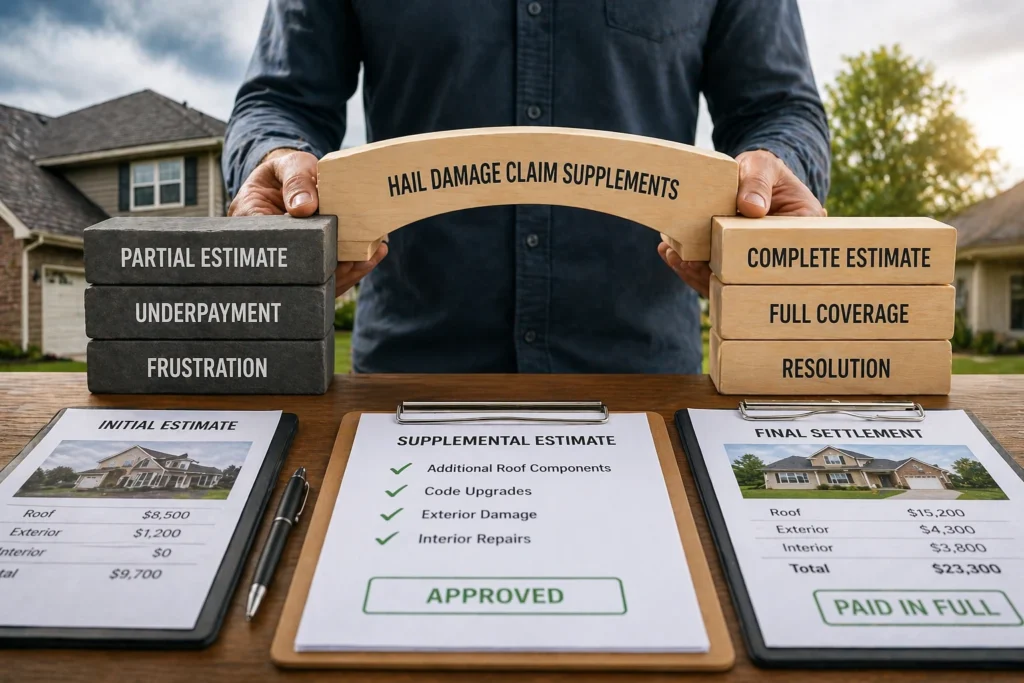
Hail damage claim supplements are the bridge between:
- A partial estimate and a complete one
- Underpayment and full coverage
- Frustration and resolution
They are not optional.
They are essential.
Final Thought
If your estimate feels incomplete, it probably is. Trust your instincts. Ask better questions. Get a second opinion. Push for clarity. Because in this process, small details create big financial outcomes. And when handled correctly, hail damage claim supplements turn incomplete estimates into accurate ones—exactly the way they should be.
FAQs
Hail damage claim supplements are revisions to an insurance estimate that include missing or underpaid items after the initial scope is reviewed.
Initial inspections are usually fast and limited, which can lead to overlooked components, measurements, and code requirements.
You should request one as soon as you or your contractor notice missing items or additional damage not included in the original estimate.
They can extend the timeline slightly, but they often result in a more accurate payout, which makes the process worthwhile.
Yes, contractors can help identify missing items, but they may not handle negotiation as effectively as a public adjuster.
Xactimate is the software insurers use to create estimates, and accurate use of it ensures all materials, labor, and costs are properly included.
Not always approval depends on proper documentation, justification, and alignment with your policy coverage.
They can be included if your policy covers ordinance or law and the upgrades are properly documented and required.
You may end up paying out of pocket for missing items or settling for incomplete or lower-quality repairs.
Most supplements are reviewed within a few days to a few weeks, depending on the complexity and responsiveness of the carrier.