
Hail doesn’t knock politely in Texas. It hits hard, fast, and without warning. One minute your roof looks fine, the next it’s taken a beating and suddenly you’re thrown into a process that feels more complicated than it should be. That’s where the question of public adjuster vs. insurance adjuster for hail claims in Texas becomes more than just a comparison. It becomes a critical decision.
I’ve seen homeowners in Tyler assume the insurance company will handle everything fairly. Sometimes they do. But often? The first estimate comes in low. Damage gets overlooked. And the homeowner is left wondering what went wrong. Here’s the truth: hail claims aren’t just about damage. They’re about representation. Let’s break it down clearly, strategically, and with real-world insight so you can make the right call from the start.
Why Hail Claims in Texas Are Different
Texas isn’t just another state when it comes to hail. It’s one of the most active hail zones in the country. That means more storms, more claims, and more pressure on insurance systems.
What That Means for You
- Higher claim volume leads to faster inspections
- Faster inspections can mean less detailed evaluations
- Less detail often leads to lower initial payouts
It’s a chain reaction. And once it starts, it’s hard to reverse.
The Nature of Hail Damage
Here’s where many homeowners get caught off guard. Not all hail damage is obvious.
Some of the most expensive issues are subtle:
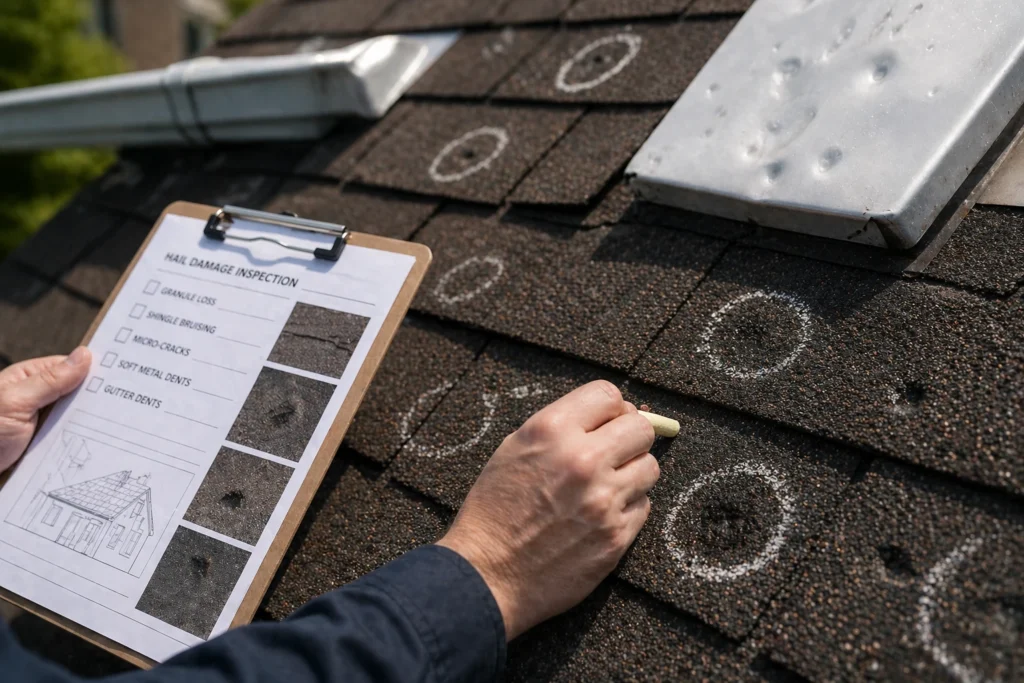
- Granule loss that shortens roof life
- Shingle bruising that weakens integrity
- Micro-cracks that lead to future leaks
- Soft metal dents that indicate broader impact
If these aren’t documented, they don’t make it into your claim. And if they don’t make it into your claim, you don’t get paid for them.
The Hail Claim Process (And Where It Breaks Down)
At a glance, the process looks simple:
- You notice or suspect damage
- You file a claim
- An adjuster is assigned
- The inspection happens
- An estimate is issued
- Payment is approved or limited
But here’s where things shift. Step 4 the inspection is where the outcome is shaped. And this is exactly where public adjuster vs. insurance adjuster for hail claims in Texas becomes the defining factor.
What an Insurance Adjuster Really Does
An insurance adjuster is assigned by your insurer. Their role is to evaluate your claim and determine how much the company should pay. That’s their responsibility. But their loyalty is to the insurance company.
Types of Insurance Adjusters
- Staff Adjusters – Full-time employees of the insurer
- Independent Adjusters – Contracted during high-demand periods
- CAT Adjusters – Deployed after major storms, often handling large volumes
Each operates under similar expectations: move efficiently, process claims, maintain consistency.
How They Approach Hail Claims
Insurance adjusters typically:
- Conduct visual inspections
- Use standardized estimating software
- Follow internal claim guidelines
They are trained professionals. But they’re also working within limits:
- Limited time per property
- High claim loads
- Pressure to stay within company benchmarks
The result? Inspections that are efficient but sometimes incomplete.
What a Public Adjuster Brings to the Process

Now let’s shift the lens. A public adjuster works exclusively for you. Their role is to ensure your claim reflects the full extent of the damage not just what’s quickly visible.
What They Actually Do
- Perform a detailed inspection of your property
- Document all forms of damage, including subtle impacts
- Analyze your policy to identify all covered items
- Build a comprehensive estimate
- Negotiate directly with the insurance company
They don’t rush. They build a case.
How They’re Paid
Most public adjusters work on a contingency basis:
- No upfront fees
- Paid a percentage of the final settlement
This creates alignment. If your claim improves, so does their compensation.
Public Adjuster vs. Insurance Adjuster for Hail Claims in Texas: Side-by-Side
Here’s a clear comparison that puts everything into perspective:
| Factor | Public Adjuster | Insurance Adjuster |
| Who they represent | Homeowner | Insurance company |
| Primary goal | Maximize claim accuracy | Control claim cost |
| Inspection approach | Detailed and thorough | Often time-limited |
| Payment | % of settlement | Salary or contract |
| Negotiation role | Advocate for homeowner | Represents insurer |
This table captures the core of public adjuster vs. insurance adjuster for hail claims in Texas. One works for you. The other doesn’t.
The Inspection Stage: Where Claims Are Won or Lost
Everything begins here. And small differences at this stage can lead to major financial differences later.
Insurance Adjuster Inspections
- Typically quick
- Focused on visible damage
- Limited by time constraints
Public Adjuster Inspections
- More detailed and methodical
- Focused on both visible and hidden damage
- Built around documentation strength
Why This Matters
If damage isn’t documented, it doesn’t exist in the claim. That single reality shapes everything that follows.
What Often Gets Missed in Hail Claims
Let’s talk specifics. Because this is where homeowners lose money without realizing it.
Commonly overlooked items include:
- Soft metal damage (vents, flashing, gutters)
- Shingle bruising beneath the surface
- Underlayment damage
- Interior water intrusion
- Code-required upgrades
Each of these can significantly increase claim value. Missing them leads to underpayment.
Supplements: The Difference Between Partial and Complete Payouts
This is one of the most important and most misunderstood parts of the process.
What Is a Supplement?
A supplement is a request for additional funds after the initial estimate.
It becomes necessary when:
- Damage was missed
- Costs increase
- Scope expands
Who Handles Supplements More Effectively?
- Insurance adjusters respond to supplements
- Public adjusters build them strategically
That difference is critical.
Why Supplements Matter
They bridge the gap between:
- An incomplete estimate
- And a fully funded repair
Without supplements, many claims remain underpaid. This is exactly why topics like “Hail Damage Claim Supplements: What Carriers Miss in Their Scope” matter so much because what’s left out of the initial estimate is often where the real financial gap exists, and closing that gap is what turns an underpaid claim into a fully covered one.
Negotiation: The Real Separation Point

Here’s where outcomes truly shift.
Insurance Adjusters
- Follow internal pricing models
- Limited flexibility
- Focus on consistency across claims
Public Adjusters
- Use documentation as leverage
- Reference policy language
- Push for full and fair compensation
They don’t just process claims they advocate for them.
A Real-World Example (Tyler, Texas)
Let’s put this into context. A homeowner in Tyler files a hail claim. The insurance adjuster inspects and issues a $10,000 estimate. It covers partial roof repairs.
A public adjuster reviews the same property:
- Identifies full roof replacement
- Documents additional damage
- Includes code upgrades
- Adds overlooked items
After negotiation, the final settlement increases to $19,000. This isn’t rare. It happens more often than most homeowners realize.
When an Insurance Adjuster Alone May Be Enough
Not every situation requires additional help.
You may not need a public adjuster if:
- Damage is minimal
- The claim is straightforward
- The estimate aligns with contractor bids
- There’s no dispute or resistance
In these cases, the process can move smoothly.
When Hiring a Public Adjuster Makes Sense
This is where public adjuster vs. insurance adjuster for hail claims in Texas becomes essential.
You should strongly consider hiring one if:
- Your claim is denied
- The payout seems low
- Damage is widespread
- The process feels unclear
- You want a second opinion
In areas like Tyler, where hail claims are frequent, having representation can make a measurable difference.
Common Mistakes Homeowners Make
Let’s be direct. These mistakes cost money.
- Accepting the first estimate without review
- Not documenting damage thoroughly
- Waiting too long to act
- Starting repairs before claim approval
- Assuming nothing was missed
Avoiding these puts you in a stronger position immediately.
Cost vs. Value: Is It Worth It?
This question always comes up.
The Cost
Public adjusters typically charge a percentage of the claim.
The Value
They often:
- Identify additional damage
- Strengthen documentation
- Improve negotiation outcomes
A Simple Comparison
| Scenario | Without Public Adjuster | With Public Adjuster |
| Initial estimate | Lower | More accurate |
| Missed damage | More likely | Less likely |
| Final payout | Often reduced | Often higher |
| Stress level | Higher | Lower |
It’s not just about cost. It’s about what you walk away with.
Texas-Specific Considerations
Hail claims across Texas come with unique challenges:
- High claim volume increases scrutiny
- Insurance companies apply stricter evaluations
- Local building codes affect repair requirements
This means your claim needs to be well-documented and defensible from the beginning.
Understanding Policy Language (Where Many Claims Get Confusing)
Here’s where things get technical and where many homeowners lose clarity. Insurance policies often include complex valuation methods such as Actual cash value, which factors in depreciation when calculating payouts. Understanding how this works can significantly impact how much you receive and whether your claim fully covers replacement costs. Knowing the difference between actual cash value and replacement cost can change how you approach your claim and your expectations.
How to Choose the Right Public Adjuster
Not all public adjusters deliver the same results.
What to Look For
- Valid Texas license
- Experience with hail claims
- Strong documentation process
- Clear communication
Questions to Ask
- How detailed are your inspections?
- How do you handle supplements?
- What’s your negotiation approach?
Clarity here prevents problems later.
Advanced Claim Strategies Most Homeowners Overlook
If you want to go beyond the basics, this section matters.
Document Everything Early
Take photos immediately after the storm. Capture:
- Roof angles (if safe)
- Gutters and downspouts
- Interior ceilings and walls
Time-stamped documentation adds credibility.
Get Independent Opinions
Don’t rely on a single inspection. Compare perspectives.
Understand Your Policy
Coverage details matter. Pay attention to:
- Deductibles
- Replacement cost vs. actual cash value
- Exclusions
Knowing your policy gives you leverage.
Public Adjuster vs. Insurance Adjuster for Hail Claims in Texas: Final Verdict
Let’s simplify it completely.
- Insurance adjusters represent the insurance company
- Public adjusters represent you
That’s the difference. And in complex hail claims, representation directly affects outcomes.
What to Do Immediately After Hail Damage
Don’t wait. Take control early.
Step-by-step action plan:
- Inspect your property safely
- Take clear, detailed photos
- File your claim promptly
- Review the estimate carefully
- Decide if you need professional representation
These steps create momentum in your favor.
Bringing It All Together
Hail claims aren’t just about damage. They’re about direction. Who inspects your property matters. Who builds your estimate matters. Who negotiates your claim matters.
That’s why understanding public adjuster vs. insurance adjuster for hail claims in Texas isn’t optional it’s essential. Because once your claim starts moving, it gains momentum. And changing course later is harder than getting it right from the beginning.
Make the right decision early. It’s not just about your roof. It’s about your outcome.
FAQs
A public adjuster represents you, while an insurance adjuster works for the insurance company.
Not always, but for denied, underpaid, or complex claims, a public adjuster can improve your results.
They usually charge a percentage of the final settlement, with no upfront fees in most cases.
Yes, by identifying missed damage and negotiating, they often help secure a higher settlement.
They focus on visible damage and use standardized tools to create an estimate based on company guidelines.
A supplement is a request for additional funds when the initial estimate doesn’t cover all the damage.
Yes, you can bring one in at almost any stage, especially if you feel the claim was underpaid.
Not necessarily strong documentation often speeds up resolution rather than slowing it down.
A public adjuster can reassess the damage, gather stronger evidence, and help reopen or challenge the claim.
For simple claims, the insurance adjuster may be enough, but for larger or disputed claims, having your own advocate is often beneficial.